Steps To Become Forklift Certified Through Your Employer
So, you wanna get forklift certified, but your boss is the one footing the bill? Smart move. Why shell out your own cash when the company practically begs for you to be qualified? It’s a no-brainer, really. Forget those sketchy online places that make you jump through hoops and cost a fortune. Your employer holds the keys to the kingdom here, and it’s usually way simpler than you think. Let’s cut through the noise and talk about how you actually get this done, straight from the horse’s mouth – your workplace.
This isn’t some philosophical debate about the nature of work. This is about getting a specific, practical skill that makes you more valuable and, let’s be honest, safer on the job. And when your employer steers the ship, the whole process gets streamlined. They’ve got a vested interest in you being properly trained, not just for compliance, but because a well-trained operator is a more efficient operator. Think about it: fewer accidents, less damage to goods, and a smoother workflow. It’s a win-win.
Why Your Employer Paving the Way is Gold
The Financial Sweet Spot
First off, let’s talk brass tacks: money. Getting forklift certified usually involves course fees, and sometimes, those aren’t pocket change. When your employer picks up the tab, it’s pure gravy. No out-of-pocket expenses for you means more cash in your pocket for, well, whatever you want. It’s a perk you shouldn’t overlook. They see the value in you having this skill, so they’re willing to invest.
Tailored Training, Real-World Relevance
Companies often partner with specific training providers or even have internal programs designed around the exact types of forklifts and materials you’ll be handling. This isn’t some generic, one-size-fits-all online fluff. This is training that’s directly applicable to YOUR job. You’re learning on equipment that mirrors what you’ll use daily, which makes a massive difference in retention and confidence. It’s practical, focused knowledge.
Meeting Compliance Head-On
Here’s the serious part: OSHA has rules. Strict ones. Employers are legally obligated to Make sure their workers are properly trained and certified to operate powered industrial trucks. When they arrange your training, they’re ticking a Key compliance box. This means you’re not just getting a cool skill; you’re helping your company stay on the right side of the law. It’s a responsibility they take seriously, and you benefit from their diligence.
Boost Your Career Prospects Internally
Getting certified through your employer often opens doors to new opportunities within that company. Maybe it’s a promotion, a chance to operate a different type of forklift, or even a move into a more senior role where that certification is a prerequisite. It’s a clear signal to management that you’re ready for more responsibility and willing to go the extra mile (or in this case, the extra pallet). Internal opportunities Are plentiful.
Initiating the Conversation: Talking to Your Boss

Source : bigrentz.com
Timing is Everything
Don’t just walk into your boss’s office demanding training. Assess the situation. Is there a clear need? Are you already being asked to do tasks that require it, even informally? Or is it something you aspire to do? If you’re applying for a new role that requires it, that’s the perfect opening. If you’re already performing some duties that border on forklift operation, that’s a strong talking point. Assessing the need is key.
Frame It as a Benefit to Them
When you bring it up, don’t just say “I want to get forklift certified.” Frame it around how it helps the company. “I’ve noticed we sometimes have a bottleneck in loading/unloading, and I believe with proper forklift training, I could help streamline that process.” Or, “I’m eager to take on more responsibilities, and obtaining my forklift certification would allow me to contribute more effectively to the warehouse operations.” Show them you’re thinking about the bigger picture. Company benefit focus.
Source : blog.rbauction.com
Research Options (Subtly)
Before you even talk to your boss, do a little homework. Are there any known local training providers? Does the company have a preferred vendor? Sometimes, employers have established relationships with training facilities or online platforms. Knowing a little bit beforehand shows initiative. You can even casually ask colleagues, “Hey, do you know how people usually get forklift certified around here?” Gathering intel pays off.
Be Prepared for the “How”
Your boss might ask, “How do you envision this happening?” Be ready with a brief idea. “I saw that OSHA Education Center offers online courses that seem Full, or perhaps there’s a local training facility you partner with?” Even if they have a specific program in mind, showing you’ve thought about it makes a good impression. It shows you’re not just expecting them to figure everything out for you. Proactive planning is impressive.
Handling the Employer-Sponsored Training Process
The Initial Approval
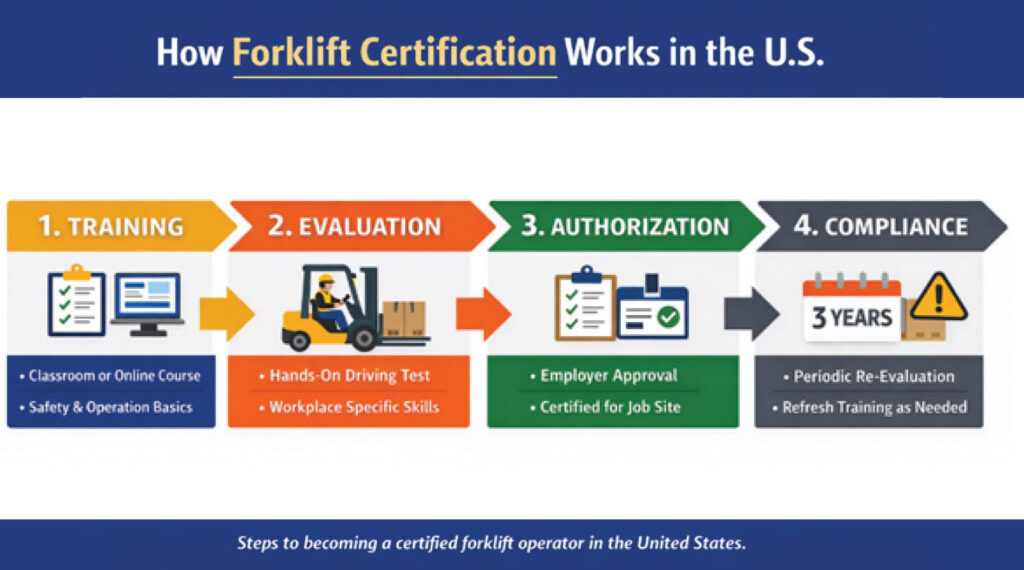
Once you’ve discussed it, the ball is in their court. Your employer will likely need to approve the training, budget for it, and decide on the specific method. This might involve paperwork, submitting a training request, or simply getting a verbal go-ahead. Don’t be afraid to follow up politely if you haven’t heard back within a reasonable timeframe. A simple, “Just checking on the status of my training request” can work wonders. Following up shows commitment.
Choosing the Right Program (Their Choice, Mostly)
They’ll decide how you get trained. This could be:
- On-site training: Often conducted by a dedicated safety manager or an experienced operator.
- Third-party training provider: They contract with an external company, either at their facility or yours.
- Online courses: Increasingly common, especially for the theoretical portion, often supplemented by practical, hands-on assessment.
Whatever they choose, trust that they’re aiming for compliance and effectiveness. Your job is to engage fully. Training method selection is their call.
The Practical Assessment: Where the Rubber Meets the Road
Theory is one thing, but actually operating a forklift is another. OSHA requires a hands-on evaluation. Your employer will Make sure this happens. This usually involves demonstrating your ability to safely maneuver the forklift, lift and lower loads, perform pre-operation checks, and recognize potential hazards in a real or simulated work environment. This is where you prove you’ve got the skills. Hands-on evaluation is Key.
Documentation and Certification
Once you’ve successfully completed both the knowledge-based and practical assessments, your employer will receive proof of your training. They are required to maintain records of who has been trained and certified. You’ll likely be issued a forklift operator card or certificate, often kept on file by the company, but sometimes given to you to carry. This is your official ticket to operate.
Understanding What “Certified” Actually Means
It’s About Competency, Not Just a Piece of Paper
Don’t get it twisted. Being “certified” means you’ve demonstrated you are competent to operate a specific type of forklift safely in your work environment. It’s not a lifelong badge of honor; it’s a verification of your current skills. Regulations often require refresher training periodically, or whenever operating conditions change significantly. Demonstrating competency is the goal.
Employer Responsibility is HUGE
The certification isn’t just on you. Your employer has a massive responsibility here. They must provide the training, Make sure the evaluation is thorough, and keep records. If something goes wrong, and the training wasn’t adequate, they’re on the hook. This is why they usually lean towards reputable training methods and providers. Employer oversight is non-negotiable.
Types of Forklifts Matter
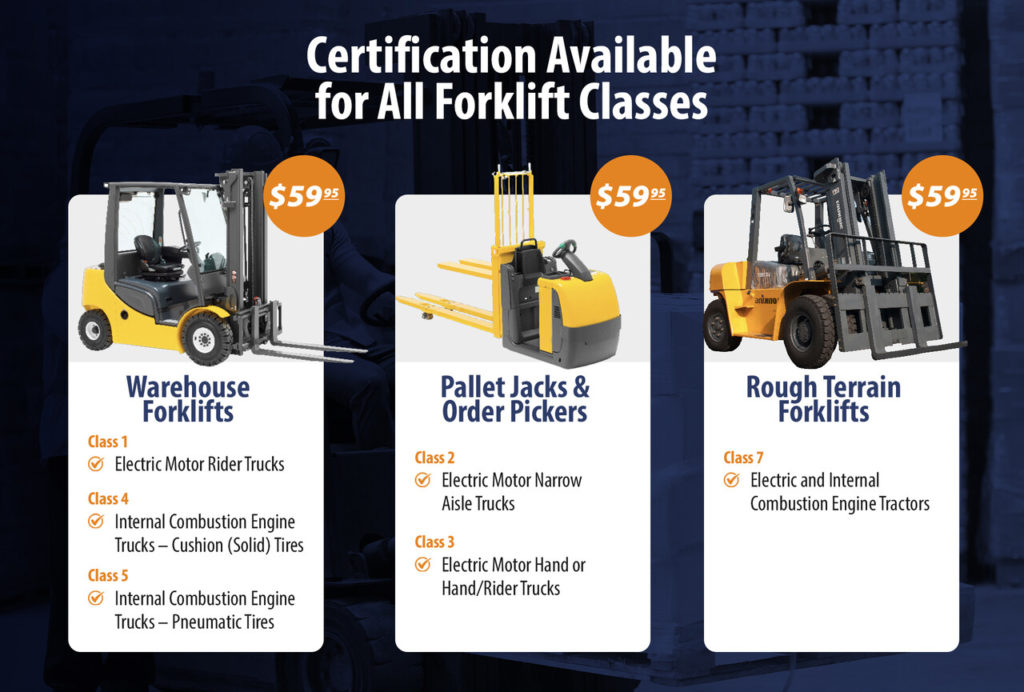
Forklift certification isn’t a monolith. There are many types of powered industrial trucks – from standard sit-down counterbalance forklifts to narrow aisle trucks, rough terrain forklifts, and order pickers. Your employer-provided training will likely cover the specific type(s) you’ll be operating. If you get trained on a standard 3-wheel electric but are then asked to operate a massive Lull telehandler, that might require additional, specific training. Specific forklift types require specific knowledge.
Frequency of Training and Evaluation
OSHA doesn’t mandate an exact frequency for recertification for all industries, but it does require evaluations at least once every three years. However, employers often implement more frequent refresher training or evaluations, especially if:
- You’re observed operating the forklift unsafely.
- You are involved in an accident or near-miss.
- Your work assignment changes significantly.
- The employer implements new safety procedures or equipment.
So, think of it as an ongoing process, not a one-and-done deal. Ongoing competency is Key.
Potential Training Methods Your Employer Might Use
The In-House Guru: Internal Training Programs
Many larger companies, especially those with dedicated safety departments, have their own internal training programs. They might have certified trainers on staff who conduct both the classroom-style learning (or online modules) and the practical driving tests. This is often the most cost-effective method for them and allows for highly customized training relevant to their specific operations. Internal expertise is valuable.
Source : certifyme.net
Contracting the Pros: Third-Party Providers
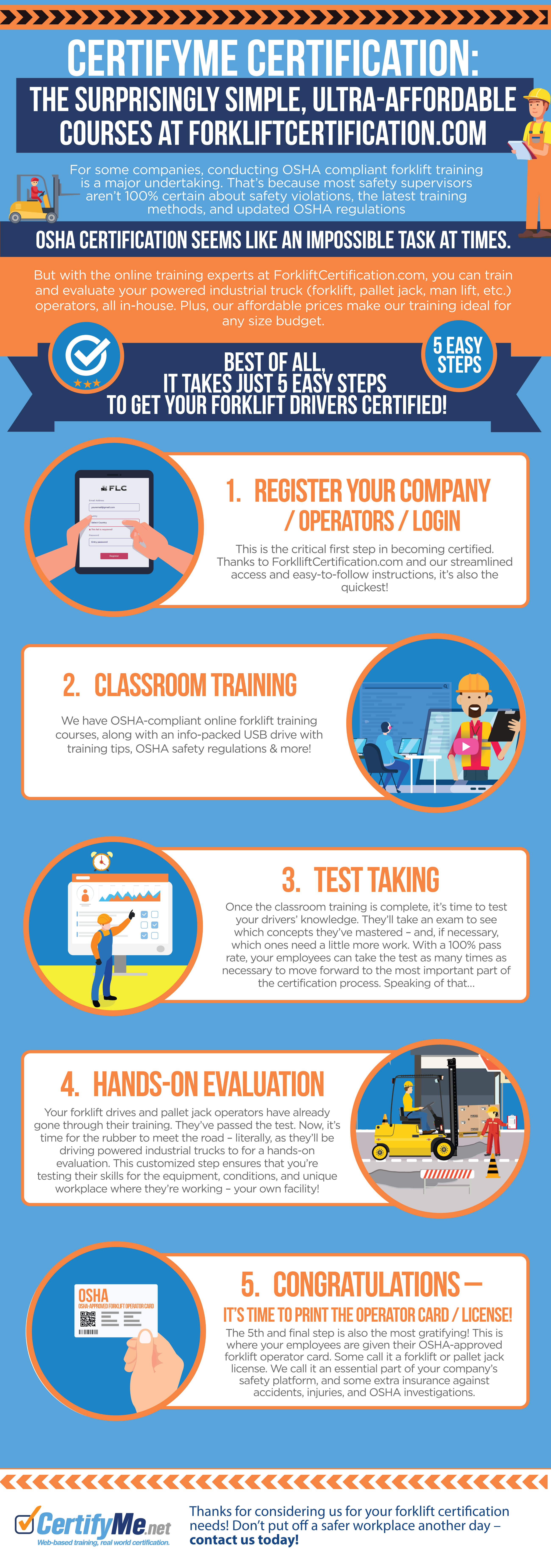
For smaller businesses or those without the internal resources, hiring an external training company is common. These specialists come in with their own curriculum, instructors, and sometimes even equipment. They Make sure compliance with OSHA standards and provide a certificate upon successful completion. Your employer pays a fee, and you get certified. It’s a straightforward transaction. Specialized training services are readily available.
The Digital Route: Online & Blended Learning
Online courses have exploded in popularity, especially for the theoretical components. You can learn about forklift types, safety regulations, hazard identification, and basic operating principles from your computer. However – and this is critical – you must still have a supervised, hands-on practical evaluation. Many companies use a blend: online theory followed by an in-person skills assessment, either internally or through a local partner. Blended learning offers flexibility.
Mentorship and On-the-Job Training (with Caveats)
Sometimes, training is more informal. An experienced operator might essentially “apprentice” a new worker. While valuable for practical skills, this must be supplemented with formal knowledge-based training and a formal evaluation to meet OSHA requirements. Simply watching someone else operate a forklift or doing it yourself without proper instruction and assessment isn’t enough. Formal assessment is a must.
What to Expect During Your Training
The Classroom/Online Portion: Knowledge is Power
This is where you’ll absorb the core information. Expect modules covering:
- Forklift Components and Controls: Understanding the parts of the machine.
- Pre-Operation Inspections: The critical checklist before you even start the engine.
- Safe Operating Procedures: How to drive, turn, lift, lower, and park safely.
- Load Stability and Handling: The physics of moving goods without disaster.
- Common Hazards and Accidents: What to watch out for – blind spots, ramps, pedestrians, etc.
- OSHA Regulations and Employer Policies: The rules of the road.
Pay attention here; this knowledge is your shield. Safety protocols are Top.
The Practical Driving Test: Show, Don’t Just Tell
This is the hands-on part. You’ll likely be asked to:
- Perform a thorough pre-operation inspection.
- Start the forklift and demonstrate basic controls (steering, acceleration, braking).
- Maneuver the forklift through a designated course, often involving tight turns and obstacles.
- Pick up, transport, and stack loads (pallets, boxes, etc.) at various heights.
- Demonstrate proper load stability awareness.
- Park the forklift safely and conduct a post-operation check.
This is where you put the theory into practice. Practical skills demonstration is key.
Hazard Recognition Scenarios
You might be put in simulated situations where you have to identify potential dangers. This could involve Handling around other workers, dealing with uneven surfaces, or operating near shelves or equipment. Your trainer will be assessing your ability to spot risks before they become problems. It’s about preventative thinking. Proactive hazard identification separates good operators from great ones.
Written or Knowledge Assessment
Before or after the driving test, you’ll likely need to pass a written test. This confirms you’ve understood the theoretical material. Questions will cover the topics mentioned in the “Classroom/Online Portion.” It’s usually multiple-choice or true/false. Don’t underestimate it; understanding the ‘why’ behind the safety rules is just as important as the ‘how’ of driving. Knowledge retention is tested.
Data: Forklift Accidents and Training Impact
The statistics don’t lie. Lack of proper training is a leading cause of forklift accidents. These incidents aren’t just inconvenient; they can be devastating, leading to serious injuries, fatalities, and significant financial losses for companies. Investing in Full training, like the kind your employer provides, directly combats these risks.
| Factor | Without Proper Training | With Proper Employer-Provided Training |
|---|---|---|
| Accident Frequency | Significantly Higher | Dramatically Lower |
| Severity of Injuries | Often Severe to Fatal | Generally Minor, Often Avoidable |
| Property Damage Costs | High (Product, Equipment, Facility) | Substantially Reduced |
| Worker Confidence & Morale | Low, Fearful | High, Empowered |
| Compliance with OSHA | High Risk of Violations | Meets or Exceeds Requirements |
| Operational Efficiency | Interrupted by Incidents | Smoother, More Productive Flow |
Statistics Spotlight
Did you know? According to OSHA data, forklift accidents result in thousands of injuries and over 100 fatalities annually. A significant percentage of these incidents are attributed to operators lacking proper training or experience. Your employer’s investment in your certification is a direct countermeasure against these grim realities. It’s about protecting you and the business. Workplace safety is a shared goal.
The ROI of Training
For employers, the cost of providing thorough training is minuscule compared to the potential costs of an accident: medical expenses, workers’ compensation claims, equipment repair, lost productivity, potential lawsuits, and OSHA fines. A well-trained operator is an asset that pays for itself many times over through increased safety and efficiency. It’s a sound return on investment.
Maintaining Your Certification: It’s Not a One-and-Done Deal
Regular Refreshers are Standard
Think of your certification like a driver’s license renewal. While the initial training gets you started, industry best practices and OSHA guidelines often recommend or require periodic refresher courses. This keeps your knowledge current and reinforces safe operating habits. Your employer should have a system for this. Refresher training is key.
Source : certifyme.net
When Assignments Change
If you move to a different department, start operating a new type of forklift, or the nature of your work changes (e.g., working in colder temperatures, handling new materials), you might need updated or additional training. The certification is specific to the conditions under which it was granted. Don’t assume your old skills cover entirely new scenarios. Adapting to new roles requires updated skills.
Performance Observation is Continuous
Your employer’s responsibility doesn’t end with the initial certificate. They are expected to continuously observe operators. If you’re seen engaging in unsafe practices, deviating from procedures, or seem to be struggling, they are obligated to step in and provide corrective training. This isn’t about micromanagement; it’s about ongoing safety management. Continuous performance monitoring ensures safety.
Accidents Trigger Re-evaluation
This one’s obvious, but Key. If you’re involved in any kind of forklift incident – even a minor bump or near-miss – expect a review. This usually involves retraining and re-evaluation to Make sure the cause is understood and corrected. It’s a Key part of the safety cycle. Incident-triggered retraining is standard procedure.
Leveraging Your New Skillset Beyond the Forklift
Increased Employability (Even Elsewhere)
While you’re getting certified through your current employer, the skills and the certification itself make you a more attractive candidate for jobs anywhere. Warehousing, manufacturing, construction – many industries need certified forklift operators. It’s a tangible skill that broadens your horizons, even if you decide to move on later. Enhanced job prospects are a major perk.
Potential for Higher Pay
Often, roles requiring forklift operation come with a higher pay rate than general labor positions. Your employer might adjust your pay upon certification, or new positions you qualify for will simply pay more. It’s a direct financial reward for acquiring a specialized skill that benefits the company. Increased earning potential is a tangible benefit.
Opportunities for Advancement
Earlier, certification can be a stepping stone. You might become eligible for lead hand positions, supervisory roles, or specialized equipment operator roles that weren’t previously accessible. It signals you’re capable of handling more responsibility and complex tasks. Think of it as leveling up in your career game. Career progression is within reach.
Becoming a Safety Support
With your training, you’re not just an operator; you’re now knowledgeable about safety best practices. You can become a valuable resource for your colleagues, helping to Build a stronger safety culture within your workplace. Your insights, gained from formal training, can contribute to a safer environment for everyone. You become a safety-conscious employee.
Frequently Asked Questions
What’s the first step to getting forklift certified at work?
Usually, the first thing you gotta do is tell your boss or supervisor you’re interested. They’ll then probably set you up with the right paperwork or point you to who handles training. It’s all about them knowing you want to learn the forklift operation.
Does my employer have to pay for my forklift certification?
Yeah, for the most part, if it’s required for your job, your employer is on the hook for the training and certification costs. It’s considered part of your job training, so they should be covering it. Think of it as an investment in a certified forklift driver.
How long does employer-provided forklift training usually take?
It really varies, but often it’s a day or two. They’ll cover the classroom stuff, like safety rules and how the machine works, and then the hands-on practical part. Some places might spread it out over a week, depending on how busy things are and the forklift training program they use.
What happens after I finish the training?
Once you pass both the written test and the practical driving test, you’ll get your forklift certification. Your employer will likely keep a record of it, and you might even get a card or certificate to show you’re qualified.
Can I get forklift certified by an external company instead of through my employer?
You can, but if your employer offers it, that’s usually the easiest route and they’ll pay for it. If you get it externally, you’ll have to pay out-of-pocket, and then you’d need to check if your employer accepts that specific forklift certification.
0 Response to "Steps To Become Forklift Certified Through Your Employer"
Post a Comment