How To Become A Certified Tax Preparer With No Experience
How To Become A Certified Tax Preparer With No Experience
So, you’re looking to jump into the tax prep game, huh? And you’ve got zero, zilch, nada experience. Sounds like a tall order, right? Most folks think you need to be some kind of accounting wizard or have a CPA tattooed on your forehead. That’s just not the case anymore. The IRS and a lot of reputable tax firms are actually looking for new blood, people who can learn the ropes and bring a fresh perspective. It’s more about dedication and understanding the fundamentals than having a decade of experience under your belt. Let’s break down how someone like you, starting from scratch, can actually make a real go of becoming a certified tax preparer.
Forget what you heard about needing a fancy degree right out of the gate. While that can certainly help, it’s not the only path. There are concrete steps you can take, training you can get, and certifications you can earn that don’t require you to have prepared a thousand returns before. We’re talking about a practical, actionable guide to get you from “I know nothing” to “I can handle this” in the world of tax preparation. Ready to dive in?
The Big Picture: What Exactly IS a Tax Preparer Anyway?

Source : youtube.com
More Than Just Filling in Blanks
Look, a tax preparer does a lot more than just punch numbers into software. They’re essentially financial detectives, problem solvers, and sometimes even mini-therapists for stressed-out clients. Your job is to understand a client’s financial situation, translate it into the language the IRS understands, and make sure they get every deduction and credit they’re legally entitled to. It’s a Key role, especially when people are totally confused about tax laws.
Client Interaction is Key
You’ll be dealing with all sorts of people. Some will be organized, with neat little folders of receipts. Others will be a glorious mess of crumpled papers and vague memories. Your ability to communicate clearly, ask the right questions, and build trust is just as important as knowing the tax code. It’s about making them feel comfortable and confident that you’ve got their back. This client relationship is Top.
Source : surgent.com

Handling the Ever-Changing Tax Code
This is the kicker: tax laws change. Constantly. What was true last year might be different this year. A good tax preparer stays on top of these changes. You’re not expected to have it all memorized on day one, obviously. But you need a commitment to continuous learning. Think of it like a doctor needing to stay updated on medical advancements. The tax code’s complexity means ongoing education is non-negotiable.
The Different Flavors of Tax Preparers
Not all tax preparers are created equal. You’ve got Enrolled Agents (EAs), Certified Public Accountants (CPAs), and then the vast majority who are simply skilled preparers. EAs have demonstrated expertise directly with the IRS. CPAs have a broader accounting license. But many, many successful preparers are neither, relying on their training, experience, and a PTIN (that’s your Preparer Tax Identification Number). Knowing these distinctions helps you see where you fit. The IRS website has great info on this.
The Foundation: Basic Requirements and Getting Started
No Degree? No Problem (Usually)
The biggest hurdle for people with no experience is often the perceived requirement of a formal education. While a degree in accounting or finance is beneficial, it’s not a universal prerequisite. Many firms and tax preparation services prioritize hands-on training and a candidate’s willingness to learn. They’d rather train someone from scratch who has the right attitude than try to retrain someone set in their ways. Your eagerness to learn is your biggest asset here.
The All-Important PTIN
This is non-negotiable. If you plan to prepare tax returns for compensation, you absolutely need a Preparer Tax Identification Number (PTIN) from the IRS. It’s how the government tracks tax preparers. Applying is straightforward and usually done online. You’ll need to provide some basic information, and there’s an annual fee. Getting your PTIN is step one for legitimacy.
Needed Skills Beyond Tax Law
You need more than just tax knowledge. Think about computer proficiency. You’ll be spending a lot of time with tax software, spreadsheets, and online portals. Good organizational skills are a must for managing client documents and deadlines. And, as mentioned, solid communication skills are Key for interviewing clients and explaining complex tax matters simply. Without these, even the smartest tax expert struggles.
Criminal Background Check? Yep.
The IRS requires all new PTIN applicants to undergo a criminal background check, specifically looking for certain tax-related crimes. This is to Make sure the integrity of the tax system. Don’t let this scare you unless you have something significant to hide. It’s a standard part of the process for anyone looking to prepare returns professionally.
Formal Training: Where to Learn the Ropes
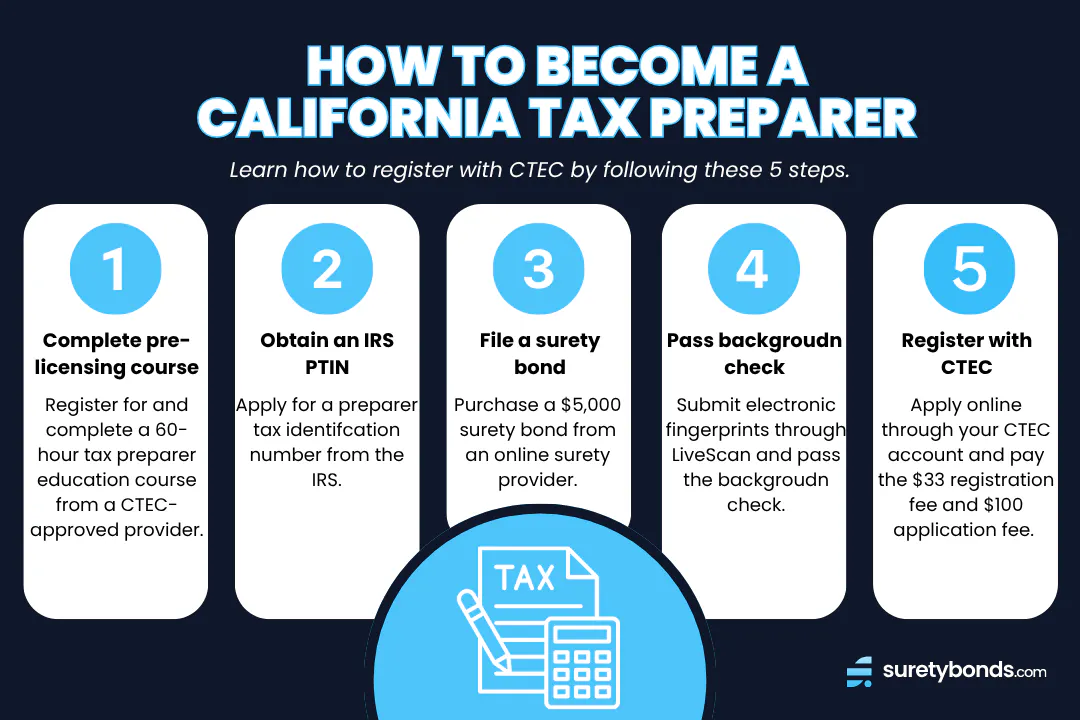
Source : suretybonds.com
In-Person Tax Courses
Many community colleges and private vocational schools offer tax preparation courses. These can range from a few weeks to a few months. They cover the basics of individual income tax returns, common forms, and deductions. This is a fantastic way to get foundational knowledge. Some courses even help you prepare for specific certifications. Look for programs that are hands-on and practical.
Online Tax Training Programs
The digital age means you can learn from your couch! Numerous online providers offer Full tax training. These courses are often self-paced, making them ideal for busy individuals. They cover everything from basic tax law to using tax software. Many also offer certifications upon completion. Companies like H&R Block and Jackson Hewitt often have their own training programs, which can be a direct pipeline to employment. Check out resources from Intuit for industry insights.
Apprenticeships and Entry-Level Roles
Some larger tax preparation firms offer structured training programs for new hires. These are essentially paid apprenticeships. You learn on the job while receiving formal instruction. This is often the most direct route to gaining practical experience. You’re literally learning and earning. It’s a bit like learning to fly a plane with an instructor right there beside you. A great starting point for many.
IRS Programs and Resources
The IRS itself provides resources, though not a formal “training program” in the traditional sense for new preparers. They have extensive publications, forms, and instructions available on their website. For those seeking a higher level of credentialing, the Annual Filing Season Program (AFSP) is an option. It involves completing continuing education courses and passing a test. It demonstrates a commitment to competence. It’s a way to stand out.
The “Certification” Question: What Does It Really Mean?
Understanding AFSP (Annual Filing Season Program)
This is probably the closest the IRS comes to a non-CPA/EA “certification” for tax preparers. Participants in the AFSP who complete continuing education requirements and pass a Full test receive a Record of Completion. This signifies that they have met the IRS’s requirements for knowledge and continued competency. It’s a voluntary program, but it shows clients you’re serious. Many firms look favorably upon this AFSP Record of Completion.
Company-Specific Certifications
Major tax preparation franchises like H&R Block and Jackson Hewitt have their own internal training and certification processes. Completing their programs often means you’re qualified to work for them. These certifications are valuable because they are recognized within that company and often indicate you’ve met their specific standards for preparing returns. It’s a ticket to work within their system.
Enrolled Agent (EA) Status
This is a higher level of credentialing. Enrolled Agents are federally licensed tax practitioners who specialize in taxation and have unlimited practice rights before the IRS. To become an EA, you generally need to pass a Full exam (the SEE – Special Enrollment Examination) or have relevant experience working for the IRS. While you can become an EA without prior tax prep experience, passing the SEE is challenging and requires significant study. It’s a prestigious designation.

Source : finepoints.biz
Certified Public Accountant (CPA)
This is the most Full accounting and tax credential. However, becoming a CPA requires a significant amount of education (often 150 credit hours), passing a rigorous four-part exam, and meeting experience requirements. Most CPAs focus on a broader range of accounting services, including auditing and consulting, though many also prepare tax returns. It’s generally overkill if your sole goal is just tax preparation, and not typically pursued by those starting with zero experience.
Handling State Requirements and Licensing
Not All States Are Created Equal
Here’s a bit of a curveball: tax preparer licensing isn’t uniform across the U.S. Some states have specific licensing requirements, while others don’t regulate non-credentialed preparers much at all. For instance, California, Oregon, and Maryland have their own registration or licensing requirements. You absolutely need to check your specific state’s board of accountancy or department of revenue.
What Do State Licenses Usually Involve?
State licensing often involves meeting certain education or experience criteria, passing a state-specific exam, and undergoing background checks. Some states might require continuing education hours beyond what the IRS mandates. It’s all about ensuring preparers meet a minimum standard of competence and ethical conduct within that state’s borders. This adds another layer to the licensing puzzle.
PTIN vs. State License
Remember, your PTIN is federal. Your state license, if required, is separate. You need both if your state mandates it. Failing to comply can result in fines or being barred from preparing returns in that state. It’s Needed to understand this distinction early on. Don’t assume your PTIN covers everything; state regulations vary significantly.
Where to Find State Information
Your best bet is to visit the official website for your state’s revenue department, tax authority, or board of accountancy. A quick search like “[Your State] tax preparer license requirements” should point you in the right direction. The National Association of Tax Professionals (NATP) also often has resources outlining state-specific rules, though their site might be behind a paywall.
Gaining Experience: From Zero to Paid Professional
Start with the Internals
The easiest way to get your foot in the door is often to work for a larger tax preparation company like H&R Block, Jackson Hewitt, or even a local accounting firm that hires seasonal staff. They provide the training, the software, and the clients. You gain Crucial experience under their umbrella. Your primary goal here is learning the workflow and client management.
Source : newsroom.unl.edu
Volunteer Income Tax Assistance (VITA)
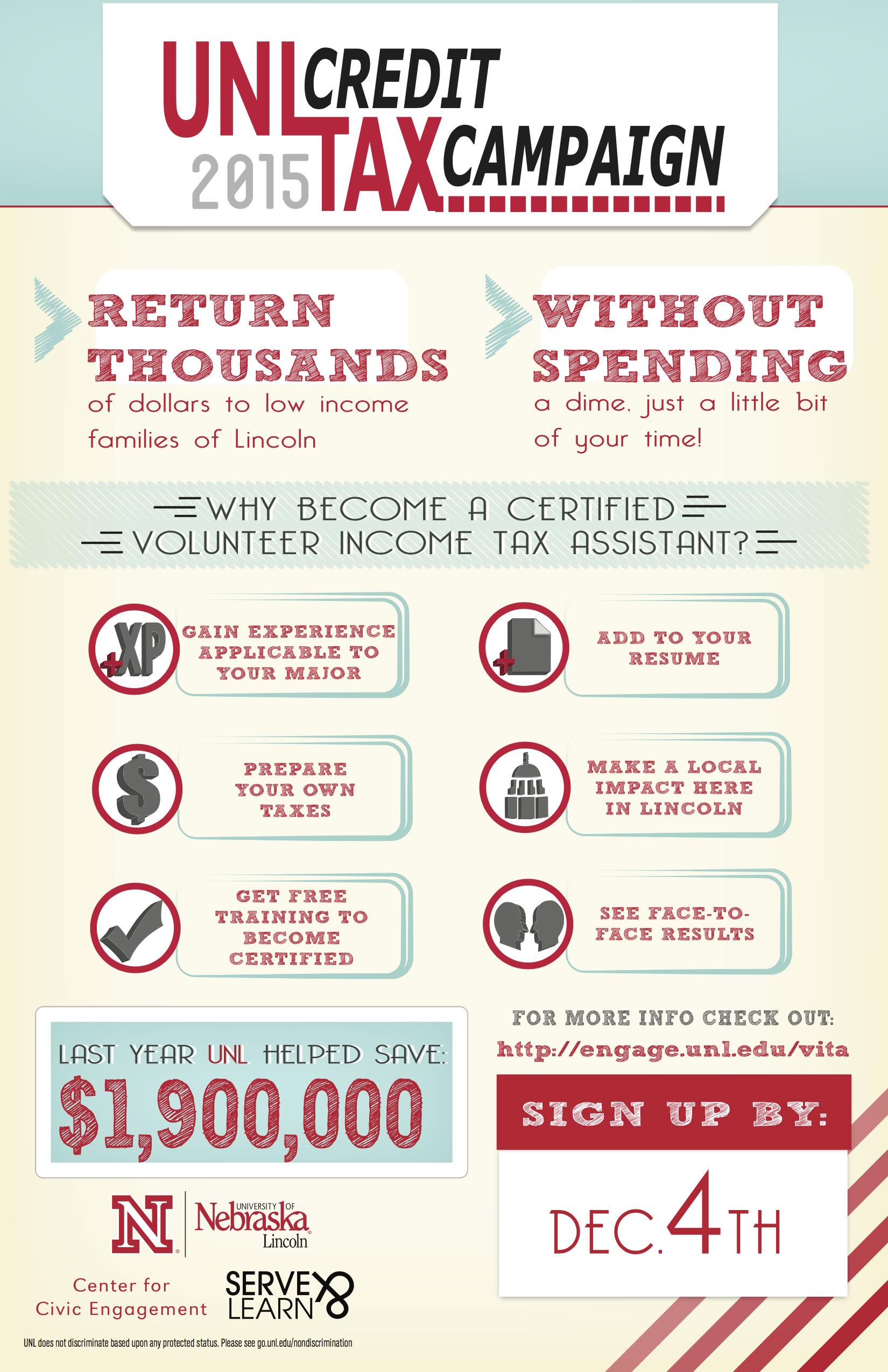
This IRS-sponsored program offers free tax help to basic, low-to-moderate income, the elderly, persons with disabilities, and those with limited English. Volunteering with VITA is an excellent way to get hands-on experience without the pressure of paid clients. You’ll work with real taxpayers and learn to navigate common tax situations. It’s a win-win: you gain experience, and you help the community. Many VITA sites offer training too. This is practical, real-world training.
Focus on Specific Tax Forms
When you’re starting, don’t try to be an expert on everything. Maybe focus on mastering Form 1040 and its common schedules (like Schedule C for freelancers or Schedule A for itemized deductions). As you gain confidence, you can broaden your scope. Specializing initially can make the learning process less overwhelming. You become the go-to person for specific tax needs.
Networking and Referrals
As you gain a little experience, even from volunteering, start letting people know what you do. Friends, family, former colleagues – you never know who might need help or know someone who does. Word-of-mouth referrals are powerful. Even if you start by preparing returns for friends and family (for free or a nominal fee), it builds your portfolio and confidence. Good client testimonials start small.
Tools of the Trade: Software and Resources
Tax Preparation Software
You won’t be doing this by hand. You’ll need tax preparation software. Major players include:
- ProConnect Tax Online: Widely used, especially by smaller firms.
- Drake Tax: Known for its user-friendly interface and affordability.
- Lacerte Tax: A more Strong option, often favored by larger firms.
- ATX Tax: Strong features and support.
- TurboTax Business/ProSeries: Industry giants, offering various levels.
Most companies that train new hires will provide access to their preferred software. Understanding how to navigate tax software efficiently is Key.
IRS Resources are Your Best Friend
The IRS website (IRS.gov) is an absolute goldmine. You’ll find:
- All the forms and instructions you could ever need.
- Publication 17, Your Federal Income Tax.
- The Tax Knowledge Review (for AFSP participants).
- Information on E-Filing requirements.
Bookmark it. Use it. Live on it. It’s the ultimate authority and Needed reference material.
Continuing Education Platforms
Beyond your initial training, you’ll need to stay current. Many organizations offer continuing education (CE) courses required for PTIN renewal and programs like the AFSP. Websites like Surgent Tax, Becker, and The Sleeter Group (though more IT-focused) offer a variety of tax-related CE. Investing in quality CE courses keeps your knowledge sharp.

Source : taxslayerpro.com
Professional Organizations
Joining organizations like the National Association of Tax Professionals (NATP) or the American Institute of Professional Bookkeepers (AIPB) can be beneficial. They offer resources, networking opportunities, advocacy, and often training materials. While some require membership fees, the benefits can outweigh the costs, especially for career development.
Setting Up For Success: Beyond the Basics
The Importance of a Good Workstation
Whether you’re working for a firm or remotely, having a reliable computer, a fast internet connection, and a comfortable workspace is Needed. Consider dual monitors for easier navigation between software and reference materials. Ergonomics matter – you’ll be sitting a lot! A stable tech setup prevents headaches.
Understanding Electronic Filing (E-File)
Almost all tax returns are filed electronically these days. You’ll need to understand the E-File process, including obtaining an Electronic Filing Identification Number (EFIN) if you plan to operate independently or for a small firm. This involves meeting certain software and security requirements. The IRS has strict guidelines for secure electronic filing.
Client Communication and Retention
Getting clients is one thing; keeping them is another. Respond promptly to inquiries. Be organized and professional. Set clear expectations about fees and turnaround times. Following up after tax season to see if they have questions or updates for the next year can significantly boost client loyalty. Happy clients come back, and they refer others.
Developing a Niche (Eventually)
As you gain experience, you might find yourself particularly good at or interested in a specific area – like small business taxes (Schedule C, K-1s), rental property income, or military tax issues. Developing a niche can make you a go-to expert and potentially allow you to charge higher fees. Don’t rush this; it comes with time and exposure. But keep an eye out for where your natural strengths lie.
Making the Leap: Your First Paid Gig
Tailor Your Resume
Even with no paid experience, highlight your training, volunteer work (like VITA), relevant computer skills, and any customer service background. Frame your lack of experience as a positive: “eager to learn,” “highly trainable,” “fresh perspective.” Mention any specific tax software you’ve trained on. Make it clear you’ve taken steps to Get the necessary skills.
Watch: How to become Tax Preparer with No Experience
Ace the Interview
Be prepared for questions about why you want to be a tax preparer, how you handle pressure, and how you approach problem-solving. Research the company beforehand. Show enthusiasm for learning. If they provide training, emphasize your excitement to dive into it. If you did VITA, have a specific example or two ready to discuss. Confidence and a positive attitude go a long way.
The Trial Period is Real
Most entry-level tax prep positions come with a trial period, especially during the busy season. This is your chance to prove yourself. Ask questions. Be proactive. Double-check your work. Show your manager you’re reliable and committed. This initial period is Key for solidifying your place and demonstrating you’re more than just someone with no prior experience.
Understand Compensation Structures
Entry-level tax preparer pay can vary widely. Some positions offer hourly wages, especially for seasonal work. Others might be commission-based or a combination. Understand how you’ll be paid and what opportunities exist for bonuses or raises based on performance and client retention. Knowing the earning potential is important.
Comparison: Paths to Becoming a Tax Preparer
| Path | Pros | Cons | Best For |
|---|---|---|---|
| Franchise Training (H&R Block, etc.) | Structured training, job placement, brand recognition. | May be tied to working for that specific company, potentially lower starting pay. | Those seeking immediate employment and a clear training path. |
| Community College/Vocational Course | Full foundational knowledge, flexible scheduling, relatively affordable. | Doesn’t guarantee job placement, requires self-discipline. | Self-starters who want solid academic grounding before seeking work. |
| Volunteer (VITA) | Real-world experience with diverse clients, no cost, builds resume. | Unpaid, limited scope (basic returns), seasonal availability. | Gaining practical skills and confidence before a paid role. |
| Online Tax Programs | Convenient, self-paced, often affordable, wide variety of options. | Quality can vary, requires motivation, less direct interaction. | Individuals needing maximum flexibility due to work or family commitments. |
| Pursuing EA Credential | High-level credential, unlimited practice rights, respected by IRS. | Requires significant study and passing a difficult exam, time-consuming. | Ambitious individuals aiming for the highest level of tax expertise. |
So, you see? There are multiple avenues to explore. Your journey to becoming a certified tax preparer with no experience isn’t about a single magic bullet. It’s about strategic learning, gaining practical exposure, and understanding the requirements. Don’t let the “no experience” part get you down. Focus on acquiring the knowledge and skills, and the opportunities will follow. The key is to start somewhere, be persistent, and never stop learning. This field needs good people, and that could absolutely be you. You’ve got this!
Frequently Asked Questions
Can you be a tax preparer without experience?
Because, yes! Many places actually offer training programs specifically designed for people with zero prior experience. They’ll teach you everything you need to know to get started and pass your certification exams. It’s totally doable!
Is tax preparer certification worth it?
But absolutely! Getting certified proves you know your stuff and builds credibility with clients. It often leads to better job opportunities and potentially higher pay. Think of it as an investment in your career.
Can I be a tax preparer without a CPA?
Because definitely! A CPA is a specific license for accountants, and you don’t need one to be a tax preparer. There are other certifications and paths you can take. Many successful tax preparers aren’t CPAs at all, they just have the right credentials for preparing taxes.
How many years does it take to be a tax preparer?
But it can be much faster than you think! Depending on the program and your dedication, you could potentially become a certified tax preparer in a matter of months, not years. Some courses are quite intensive and get you ready quickly.
What skills are most important for a tax preparer?
Because attention to detail is huge! You also need to be good with numbers, have strong communication skills to explain things to clients, and be proficient with tax software. Staying organized and keeping up with tax law changes is key too.
0 Response to "How To Become A Certified Tax Preparer With No Experience"
Post a Comment